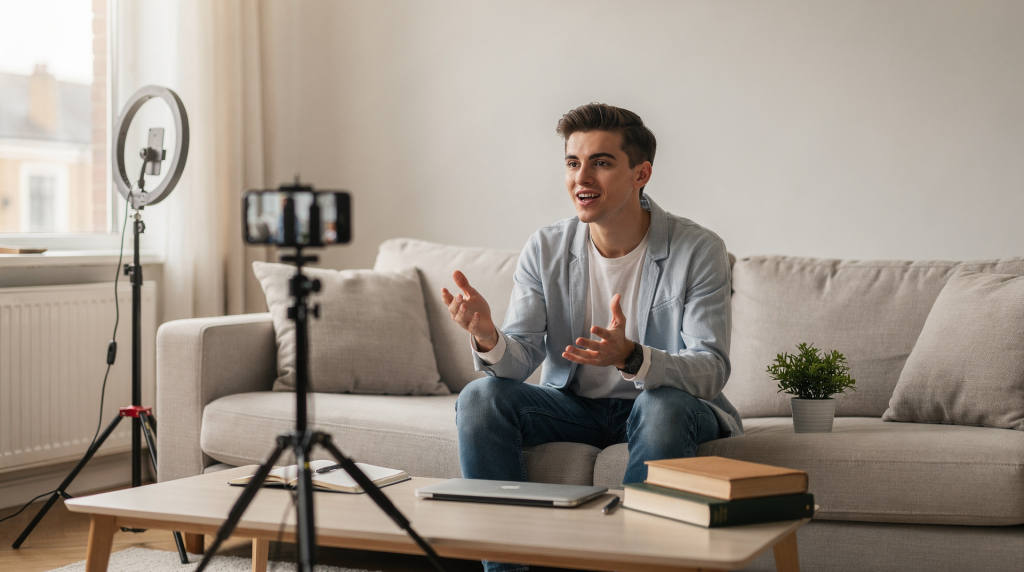
Short-form video earns its place when every second feels immediate, useful, and watchable even on mute. The formats that actually perform combine a clear hook, a single sharp message, and a payoff that lands before the viewer’s thumb moves on. In real estate, that might mean showing a listing’s best feature in the first breath, revealing a lighting trick that makes a cramped room breathe, or cutting a drone teaser so tight that the property stays in someone’s mind all day.
Why Short-Form Video Still Wins
Scrolling speed hasn’t slowed down. The job of a short video isn’t to explain everything — it’s to grab attention, deliver one useful idea, and give viewers a reason to keep watching, save, share, or click through to the full listing. For agents and property videographers, this means a 15-second Reel can do more for a listing than a 3-minute walkthrough that nobody starts.
The best-performing formats almost always serve one of three goals:
- Discovery: reach new viewers quickly — think neighborhood highlights, quick property teasers, or myth-busting clips that stop the scroll cold.
- Engagement: start comments, saves, and shares — behind-the-scenes from a shoot, relatable mistakes, or a reaction to a viral home tour.
- Conversion: move people toward a profile visit, inquiry, or booking — case studies, process videos, or a before-and-after edit that proves you can make a listing shine.
Across platforms, short-form content works hardest when it’s designed mobile-first and cut tight enough that every frame justifies its existence. Vertical 9:16 isn’t a trend; it’s the default canvas for property video that actually gets watched.
What Makes a Short-Form Video Idea Worth Making
A good idea isn’t just “short.” It’s built to survive the feed. For real estate, that means the concept has to communicate space, light, or lifestyle without relying on a long setup. The strongest ideas share a few traits:
- Easy to understand in the first 1–3 seconds — a striking exterior shot, a surprising interior angle, or a bold text hook like “This 800sqft condo feels twice its size.”
- Strong enough to hold attention without a lengthy intro — no “Welcome to this beautiful home,” just the payoff.
- Simple enough to explain in one video — one tip, one transformation, one myth.
- Specific enough to feel relevant to a clear audience — first-time buyers, luxury sellers, fellow videographers.
- Flexible enough to turn into a series — if you can spin one lighting fix into five angles, you’ve got a content pillar.
If an idea needs too much context — say, explaining the entire market before showing a property — it belongs in a longer format or should be split into multiple clips that each carry their own weight.
Best Short-Form Video Ideas That Work Across Social Media
1. Quick tips and one-minute lessons
This is the workhorse format because it hands viewers immediate, usable value. In property video, a single practical tip can save an agent hours of frustration or make a listing stand out tonight.
Use it for:
- A single practical tip — like how to shoot a small bathroom without distorting proportions.
- One mistake people should avoid — panning too fast, ignoring vertical framing, relying on overhead lights.
- A before-and-after fix — straightening a horizon, balancing window light, stabilizing handheld footage.
- A fast breakdown of a process — how to capture a room’s flow in three shots.
Example angles:
- “3 editing mistakes that make listing videos feel slow”
- “One framing rule that instantly improves phone video for real estate”
- “How to make a room look bigger on camera without lying”
Why it works: easy to package, easy to save, and easy to turn into a series that positions you as the go-to expert who actually shoots homes every week.
2. Behind-the-scenes clips
People trust process more than polish. Showing what happens before the final cut — the messy setup, the lighting test, the drone pre-flight check — builds credibility that a slick reel alone can’t. For real estate, this is where you prove you’re not just pointing a camera; you’re solving problems on site.
Use it for:
- Setup and prep — arriving at a property, scouting angles, dealing with clutter.
- Location scouting — finding the hero shot in a nondescript neighborhood.
- Lighting decisions — balancing a bright window with a dark interior in real time.
- Gear packing — what actually comes on a shoot day versus what stays in the bag.
- On-site troubleshooting — fixing flicker, hiding cords, working around weather.
Example angles:
- “What a shoot day actually looks like from load-in to final clip”
- “How we light a small condo living room in under 5 minutes”
- “The difference between a rushed and planned property shoot”
Why it works: builds trust with agents and sellers, shows expertise without sounding promotional, and gives followers a reason to return for the next real-world scenario.
3. Before-and-after transformations
Transformation content is naturally satisfying because the change is instant and undeniable. In property video, the jump from raw footage to polished edit can be the strongest proof of your value — and it’s perfectly suited to short-form.
Use it for:
- Editing comparisons — ungraded log footage next to a color-corrected final.
- Visual improvements — a cluttered room versus a styled, camera-ready version.
- Room styling — virtual staging before/after or simple furniture rearrangement.
- Color correction — fixing mixed lighting, making whites actually white.
- Audio cleanup — removing echo, wind noise, or background hum.
- Thumbnail redesigns — how a single frame choice changes click-through.
Example angles:
- “Raw clip vs final edit of this lakefront listing”
- “Empty room vs staged room on camera — what actually sells”
- “Bad audio vs cleaned-up audio in a walkthrough”
Why it works: the value is visible instantly, it creates curiosity about your process, and it requires minimal explanation — the images do the heavy lifting.
4. Myth-busting and mistake-fixing videos
These land hard because they challenge assumptions that cost agents time and money. In real estate video, myths are everywhere — from gear myths to editing myths — and correcting them positions you as the practical voice who actually shoots properties.
Use it for:
- Correcting a common belief — “You need a cinema camera for luxury listings.”
- Clearing up confusion — the difference between a walkthrough and a social teaser.
- Showing what not to do — the fisheye effect, the endless pan, the music that overwhelms the space.
- Explaining a better workflow — why shooting with the edit in mind saves hours.
Example angles:
- “You do not need expensive gear to shoot better listing video”
- “Why more transitions do not always make a property video feel faster”
- “The biggest mistake people make with vertical video for real estate”
Why it works: triggers attention, encourages comments from people who disagree or want to learn more, and positions you as a practical expert who’s been on site.
5. Mini tutorials
Mini tutorials are among the most valuable short-form formats because they teach a skill in a small, repeatable package. For property videographers and agents, a 30-second tutorial on framing a kitchen or cutting a teaser can be saved, shared, and acted on immediately.
Use it for:
- Step-by-step fixes — how to level a handheld shot in post.
- Quick setups — one-light solution for a dark bedroom.
- One software feature — using keyframes to create a smooth zoom.
- One filming technique — the slider move that adds production value without a gimbal.
- One posting workflow — exporting for Instagram without quality loss.
Example angles:
- “How to frame a shot in 3 steps so the room feels spacious”
- “How to choose a strong opening shot for a listing teaser”
- “How to cut a video for retention — the 3-second rule”
Why it works: strong search potential, high save rate, and easy to repurpose into carousels or longer posts that dive deeper into the technique.
6. Lists and quick roundups
List videos are easy to follow and simple to produce in batches. In real estate, a quick roundup of “5 shots every property video should include” or “4 tools that speed up your edit” gives immediate structure to someone who’s overwhelmed.
Use it for:
- Tools — gimbals, apps, lenses that survive a shoot day.
- Tips — composition rules, lighting hacks, audio fixes.
- Common errors — the mistakes that make a listing look amateur.
- Shot ideas — the detail shots, the hero wide, the transition moment.
- Content themes — weekly series ideas for agents.
Example angles:
- “5 short-form video ideas for this week’s listings”
- “4 shots every property video should include — and why”
- “3 ways to improve your hook in the first second”
Why it works: clear structure, good pacing, and easy for viewers to scan and remember — especially when they’re about to shoot their own content.
7. Reaction and response videos
These work especially well when you respond to a trend, question, or misconception that’s already circulating. For real estate, reacting to a viral home tour or a popular editing trick lets you join the conversation while showcasing your own eye.
Use it for:
- Comment replies — turning a follower’s question into a quick video.
- Industry takes — your opinion on a new platform feature or shooting style.
- Reactions to a trend — does that “day to night” transition actually help a listing?
- Quick explanations of a viral clip — why a certain edit held attention or fell flat.
Example angles:
- “Would this viral video work for a listing? Let’s break it down.”
- “Here is why this edit holds attention — and what we can steal for property teasers.”
- “This is what the trend gets right and wrong for real estate video.”
Why it works: feels timely, creates a conversation, and helps build a community around your practical, no-fluff approach.
8. Story-driven micro content
Short stories can outperform plain tips because they create emotional momentum. In property video, a 30-second story about a shoot that almost fell apart or the one change that transformed a listing’s performance sticks with viewers longer than a generic tip.
Use it for:
- A problem and solution — the listing that looked terrible on camera until you changed one thing.
- A shoot that went wrong — weather, gear failure, tight timeline, and how you saved it.
- A surprising outcome — the unassuming house that generated a bidding war after the video went live.
- A lesson learned on the job — why you now always scout at the same time of day as the shoot.
Example angles:
- “We had 20 minutes to save this shoot before the storm hit”
- “The one change that fixed this listing video — and it wasn’t the camera”
- “What happened when we changed the opening shot from exterior to interior”
Why it works: holds attention through narrative tension, feels more authentic, and makes the content memorable when an agent is deciding who to hire.
Short-Form Video Ideas by Goal
Different stages of a viewer’s journey demand different formats. When you’re building a real estate brand or a video production business, aligning the idea with the goal keeps your content strategy from becoming a random collection of clips.
| Goal | Best video ideas | Why they work |
|---|---|---|
| Awareness | Trends, myth-busting, reactions, quick hooks (e.g., property teasers, neighborhood highlights, “I can’t believe this is 900sqft”) | They stop the scroll fast with a visual or statement that demands attention |
| Engagement | Opinion clips, story posts, comment replies, behind-the-scenes from a shoot | They invite conversation and make viewers feel part of the process |
| Saves | Tutorials, checklists, how-tos, fixes (e.g., “3 camera settings for bright windows”) | They give practical value that viewers want to reference later |
| Shares | Relatable mistakes, surprising stats, transformation clips (e.g., raw vs edited listing) | They are easy to pass on because the value or emotion is immediate |
| Leads | Behind-the-scenes, process videos, case studies, client results | They build trust and credibility by showing real work and outcomes |
How to Turn One Idea Into 10 Videos
A strong short-form strategy doesn’t demand a new brainstorm every morning. One solid topic — say, “making a small property look spacious on camera” — can fuel weeks of content if you shift the angle. This is how busy videographers and agents stay consistent without burning out.
For example, a single theme like “better property video” can become:
- One mistake to avoid — using a focal length that compresses space too much.
- One gear tip — the wide lens that doesn’t distort edges.
- One framing rule — shooting from a corner to show depth.
- One lighting fix — bouncing light off a ceiling to open up shadows.
- One edit before-and-after — correcting verticals in post.
- One behind-the-scenes clip — setting up the shot in a tight bedroom.
- One checklist — 5 things to remove from a room before filming.
- One client result — the listing that got 3x inquiries after the video.
- One common myth — “You can’t shoot a small room on a phone.”
- One comment reply — answering a follower’s question about lens choice.
This approach turns your everyday expertise into a library of content that feels fresh without requiring constant reinvention.
A Simple Framework for Picking the Right Idea
Before you hit record, run the idea through this filter. It saves you from spending an hour on a clip that won’t connect — especially important when you’re on location and time is limited.
- Can the idea be understood quickly — within the first couple of seconds, even without sound?
- Can it be filmed without a complicated setup — using the gear you actually bring to a property?
- Does it solve a real problem or create a clear payoff — for an agent, a seller, or a fellow creator?
- Can it be explained in one main point — or does it try to teach three things at once?
- Can it be reused as a series later — is there enough depth to explore from multiple angles?
If you answer yes to most of these, the idea is probably worth making. If not, refine it until it fits — or save it for a longer format where you have room to build context.
Common Mistakes With Short-Form Content
Even experienced creators slip into these traps. In real estate video, where the pressure is to show everything, the mistakes can be especially costly because they lose the viewer before the listing’s best feature ever appears.
- Trying to cover too much. One short video should do one job. If you try to showcase the kitchen, the backyard, the primary suite, and the neighborhood in 20 seconds, retention drops and nothing sticks. Pick the hero moment.
- Weak opening. If the first few seconds don’t create curiosity — a static exterior shot with no movement, a slow fade from black — most viewers swipe away before the point lands. Start with motion, a strong statement, or the most compelling visual.
- Too much setup. Long introductions waste the format. “Hi, I’m here at 123 Main Street, and today I’m going to show you…” — by the time you finish, the audience is gone. Start with the result, the problem, or the strongest visual.
- No clear payoff. Viewers should know why they stayed by the end. A video that feels unfinished — a walkthrough that just stops, a tip without a takeaway — rarely performs well. End with a clear next step, a summary, or a satisfying conclusion.
- Inconsistent format. Switching styles every time makes it harder to learn what your audience responds to. If you’re known for quick lighting tips, don’t suddenly post a slow-motion lifestyle reel without context. Consistency builds recognition.
Best Practices for Making Short-Form Videos Work
These are the habits that separate videos that get watched from those that get scrolled past — tested on real shoots and real listings.
- Start with motion, contrast, or a strong statement — a drone push-in, a door opening to reveal a bright space, or a bold text hook.
- Keep the framing simple and visually clean — remove clutter from the shot, both in the room and in the composition.
- Use captions when the message matters — not just for accessibility, but because many viewers watch without sound. Highlight key features in text.
- Cut anything that does not support the main point — that extra second of a wall, the repeated pan, the “um.”
- Make the ending feel complete — a quick logo, a call to save, or a visual button that signals the video delivered on its promise.
- Use the same content pillar more than once — repetition builds authority and makes production faster.
For most platforms, vertical 9:16 framing is still the safest default, and the opening matters more than the rest of the clip because it decides whether the viewer keeps watching. On a listing teaser, that opening might be the one architectural detail that makes the property memorable — lead with it.
Short-Form Video Ideas That Work Especially Well for Real Estate and Visual Brands
Since your content lives in the world of property video, these ideas are built to show real value instead of talking about it abstractly. They’re formats I’ve used repeatedly because they translate the physical space into something that feels immediate on a phone screen.
- Room transformation clips — empty to staged, cluttered to camera-ready, or a virtual staging reveal.
- “Before the edit / after the edit” — raw log footage next to the color-graded, stabilized final.
- Fast walkthrough highlights — 10 seconds of the best angles cut to a beat, no filler.
- Gear setup in a real home — showing exactly how you rig a slider or position a light in a lived-in space.
- Lighting fixes for difficult rooms — a dark basement, a sun-drenched living room, a bathroom with no windows.
- One-shot composition tips — how to use leading lines, symmetry, or foreground elements to make a room feel deeper.
- Drone teaser cuts — a 15-second aerial sequence that reveals the property and its surroundings.
- Social teasers from a full listing video — pulling the strongest 20 seconds to drive traffic to the complete tour.
These formats work because they demonstrate competence in the exact situations agents and sellers care about. They’re not theory; they’re proof.
Checklist: Is Your Short-Form Idea Strong Enough?
Use this quick check before you invest time in production. It’s designed to catch weak ideas early — especially helpful when you’re planning a batch of content for the week.
- Does it fit into one main point — or are you trying to say too much about a property?
- Is the hook visible or understandable immediately — even on mute, even in a busy feed?
- Can the payoff be seen in under a minute — a transformation, a tip, a reveal?
- Will someone save, share, or comment on it — does it trigger a reaction beyond a passive view?
- Can you make a second version later — is this idea part of a larger series you can sustain?
If the idea passes this test, it’s usually strong enough to film. If it stumbles on more than one question, tighten the focus before you pick up the camera.
FAQ
What are the best short-form video ideas for beginners?
Start with quick tips, behind-the-scenes clips, before-and-after transformations, and simple tutorials. For someone new to property video, that might mean filming a 30-second lighting fix on your phone, showing how you prep a room, or comparing a raw phone clip to a lightly edited version. These formats are easy to produce and quickly reveal what your audience finds valuable.
How long should a short-form video be?
The length should match the idea, not a fixed number. Most strong property clips stay tight: if you can make the point in 15–30 seconds — like a single composition rule or a before/after — keep it there. If the idea needs more room, such as a mini tutorial on editing, keep the pacing sharp and cut anything that doesn’t earn its place. The goal is to respect the viewer’s time while delivering the full value.
What kind of short videos get the most engagement?
Videos that are useful, visually clear, or emotionally engaging tend to perform best. In real estate, that means tutorials (how to shoot a bright window), transformations (a cluttered room made camera-ready), reaction clips (responding to a viral home tour), and relatable mistakes (the pan that made everyone dizzy). The common thread is that they give the viewer something to take away — a tip, a feeling, or a reason to comment.
How do I come up with ideas consistently?
Build around content pillars, then reuse each pillar in different formats. For property video, pillars might be “shooting techniques,” “editing fixes,” “on-site stories,” and “gear insights.” One topic — like handling mixed lighting — can become a tip, a story about a difficult shoot, a checklist, a before-and-after, or a reaction to a common myth. This system removes the pressure of constant invention and keeps your feed active.
Should every short video be trend-based?
No. Trends can give you a temporary boost, but evergreen content builds a more stable library that works for months or years. For real estate, a practical video on “how to make a small living room look bigger” will be relevant long after a dance trend fades. The best mix is usually a foundation of practical value with occasional trend participation to stay visible in current conversations.
Conclusion
The best short-form video ideas are the ones that solve a problem, show a transformation, or create a quick emotional response. If a video is simple to understand, fast to watch, and useful enough to remember — whether it’s a lighting trick for a dark hallway or a 20-second teaser that makes someone stop and save a listing — it has a real chance to perform.
For brands, creators, and real estate professionals, the most effective strategy isn’t chasing random trends. It’s building repeatable formats that turn everyday expertise into content people actually want to watch. When your short-form video feels like a natural extension of the work you already do — shooting homes, solving on-site problems, editing for impact — consistency stops being a grind and starts being a system that brings in leads.