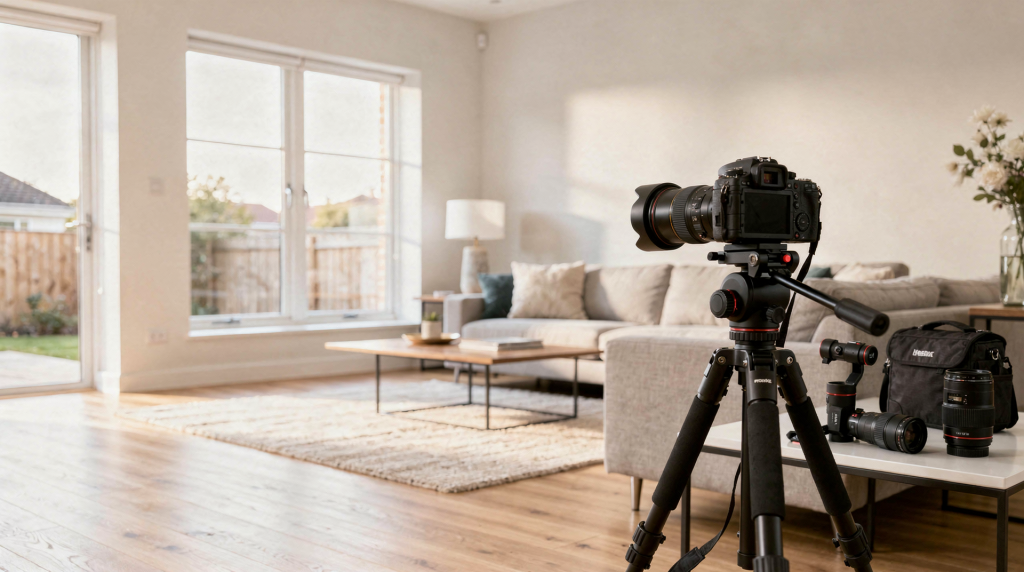
When you’re walking backwards down a narrow hallway, one eye on the flip-out screen and the other on the chandelier you’re about to bump into, you don’t need a spec‑sheet champion. Real estate videography isn’t about producing cinematic masterpieces — it’s about making a 1,200‑square‑foot condo feel like a place someone wants to wake up in. That means your camera has to handle mixed daylight and warm tungsten, keep focus locked on the fireplace as you pan to the kitchen, and give you footage that’s clean enough to deliver to an agent the same afternoon.
The short version: the Sony Alpha a7 IV, Canon EOS R6 Mark II, and Sony FX30 are among the strongest all‑around choices for serious real estate videography, while the DJI Osmo Pocket 3 is a standout for solo creators who want fast, stabilized walkthroughs and social‑ready clips.
What matters most in a real estate video camera
Real estate video has a different job than filmmaking. You are usually moving through tight rooms, working with windows that blow out and corners that disappear into shadow, all while trying to make every space look naturally bright and larger than it really is. The camera should solve practical problems first — it’s a production tool, not a trophy.
The features worth prioritizing
- 4K recording — gives you room to crop slightly in post, digitally stabilize handheld shots, and deliver sharper listing footage that holds up on large screens.
- 4K 60fps or better — essential for smoothing out motion when you pan or walk; it also gives you the option to slow down a reveal shot to 80% without jerkiness, which is a common request for luxury property teasers.
- 10‑bit color — makes correcting tricky indoor lighting far easier. In a room lit by a mix of daylight windows and warm overheads, 8‑bit footage often falls apart with banding in the subtle wall gradients. 10‑bit keeps your grade clean.
- Reliable autofocus — matters enormously when you’re moving from room to room and can’t constantly pull focus by hand. You want face/eye detection that sticks to an agent talking to camera, and wide‑area tracking that doesn’t hunt on a curtain as you glide past.
- In‑body stabilization or strong lens stabilization — reduces micro‑jitters that ruin walkthroughs. IBIS alone won’t replace a gimbal, but it handles the small bumps and makes gimbal‑assisted shots look even smoother.
- Microphone input — useful if you record agent narration, on‑camera introductions, or even room notes for later voiceover.
- Good low‑light performance — critical for basements, windowless bathrooms, twilight exteriors, and those beautiful blue‑hour pool shots agents love. A clean image at ISO 3200–6400 gives you flexibility without needing to flood rooms with portable lights.
Best cameras for real estate videography in 2026
| Camera | Best for | Why it stands out |
|---|---|---|
| Sony Alpha a7 IV | Overall balance | Full‑frame, superb autofocus, solid 4K 60p, and a proven hybrid that handles walkthroughs, agent interviews, and still photos without breaking stride. |
| Canon EOS R6 Mark II | Walkthroughs and luxury listings | Unlimited 4K 60p 10‑bit internal recording, strong IBIS, and dependable subject tracking — built for long takes through high‑end homes. |
| Sony FX30 | Video‑focused shooters | A compact Super35 body with S‑Cinetone color, active cooling for non‑stop recording, and menu systems aimed at production workflows rather than hybrid photography. |
| Panasonic GH7 | Controlled, video‑first setups | A Micro Four Thirds body beloved by creators who prioritise an extensive video toolkit and don’t need full‑frame shallow depth of field. |
| Blackmagic Pocket 4K | Editors who want grading flexibility | Rich BRAW files that give you enormous latitude in post — ideal if you build a colour grade around the property’s palette and spend time on finishing. |
| Sony A7C II | Compact full‑frame option | Full‑frame quality in a travel‑friendly body that rides on smaller gimbals all day without fatigue, and performs well in dim interiors. |
| Canon EOS R8 | Lightweight full‑frame choice | Minimal weight with a full‑frame sensor; a no‑fuss option for agents who want to self‑shoot listing teasers and still pull a clean image. |
| DJI Osmo Pocket 3 | Fast social clips and solo walkthroughs | Tiny 3‑axis gimbal built in, instant vertical video, and point‑and‑shoot simplicity — turns a 10‑minute walkthrough into a Reel faster than any interchangeable‑lens rig. |
The best camera depends on how you shoot
A camera that works well for a full‑time videographer may be overkill for an agent shooting three listings a month. The right choice depends on your actual shoot‑day workflow, not just the price tag.
1. Best overall: Sony Alpha a7 IV
The Sony Alpha a7 IV is the closest thing to a “do‑everything” body for real estate videographers who need to shoot walkthroughs, agent spiels, and occasional stills on the same day. Its full‑frame sensor delivers clean, professional‑looking footage across different property types, and the autofocus is genuinely sticky — when you’re performing a slow gimbal reveal from the entryway into an open‑plan living room, you can trust it to hold focus on the far wall instead of wandering. The colour science leans neutral, which makes quick grading for listing portals straightforward.
Why it works well for real estate: the image quality holds up well in mixed light, the autofocus saves time on multi‑room shoots, and the body comfortably switches between video and photo use. It’s flexible enough for both listing work and the kind of branded agency content that involves on‑camera talent.
Best for: videographers who want one reliable camera for most real estate jobs.
2. Best for walkthroughs: Canon EOS R6 Mark II
If your bread and butter is the full‑property walkthrough — smoothly moving from the foyer, past the dining area, through the kitchen, and out to the patio — the Canon EOS R6 Mark II is exceptionally practical. Unlimited 4K 60p 10‑bit internal recording means you don’t have to stop after 30 minutes because of an artificial limit or overheating. The IBIS does a superb job of stabilising handheld motion, so even if you’re not on a gimbal, your footage looks controlled. And Canon’s Dual Pixel AF tracks subjects with a tenacity that’s a lifesaver when you’re walking backwards through a doorway and can’t see the screen properly.
Why it works well for real estate: the 4K 60p gives you the smooth motion buyers expect in luxury listings, 10‑bit internal recording lets you balance daylight windows against warm interiors without degrading the image, and the stabilisation means you can skip a gimbal for quick social cuts. The colour science tends to render woods and warm neutrals in a pleasing way straight out of camera.
Best for: luxury listings, walkthrough‑heavy shooting, and agents who want a dependable hybrid body that can also pull excellent stills.
3. Best video‑first body: Sony FX30
The Sony FX30 is built for video from the ground up. It lacks a viewfinder for stills, which might seem like a limitation, but for a property videographer it means the body is lighter, easier to balance on a gimbal, and less expensive than a full‑frame hybrid. Its Super35 sensor is no slouch in good light, and S‑Cinetone gives you a ready‑to‑deliver colour profile that looks natural without heavy grading — a huge advantage when an agent expects the video the next morning. Active cooling means you can record uninterrupted 4K for as long as your battery and media allow, which matters on those days when you’re shooting multiple large properties back‑to‑back.
Why it works well for real estate: the menu system and button layout are optimised for video, it sits beautifully on a gimbal, and the internal fan eliminates overheating anxiety. If you also create branded content or social videos where a shallow depth of field isn’t everything, the FX30 is a strong workhorse.
Best for: videographers who want a dedicated video camera rather than a hybrid body.
4. Best compact full‑frame option: Sony A7C II
Shoot days can be long — sometimes six properties in different parts of town. The Sony A7C II earns its keep by giving you full‑frame latitude in a body that’s noticeably smaller and lighter. When mounted on a lightweight gimbal, the combo stays agile; you can weave through tight hallways without feeling like you’re piloting a cinema rig. The in‑body stabilisation is solid, and the low‑light performance is strong enough to shoot dim secondary bedrooms at ISO 6400 without excessive noise.
Why it works well for real estate: compact size reduces fatigue on all‑day shoots, full‑frame sensor delivers clean files even when you’re pushing the ISO indoors, and it’s a genuinely capable hybrid for the occasional stills the agent requests at the end of the session.
Best for: solo shooters, travel‑heavy work, and anyone who values a small rig that doesn’t intimidate homeowners.
5. Best for agents: Canon EOS R8
An agent who wants to shoot their own listing teasers doesn’t need a production‑ready cinema body; they need a camera they can grab, point, and trust to deliver a clean full‑frame image. The Canon EOS R8 fits that niche perfectly. It’s remarkably light, has the same sensor and autofocus system as the R6 Mark II (without the IBIS), and handles self‑shot content easily because Canon’s face tracking will keep the agent sharp when they turn to the camera and talk about the closet space.
Why it works well for real estate: it’s lightweight enough to hold for a 15‑minute run‑and‑gun walkthrough, full‑frame quality helps even in poorly lit model homes, and the autofocus means you can set it up on a tripod and let it track you as you walk through the space.
Best for: agents producing their own marketing content.
6. Best for social‑first property videos: DJI Osmo Pocket 3
The Osmo Pocket 3 is a tool that solves a very specific real‑world problem: getting smooth, vertical, engaging property footage with almost zero setup time. Its built‑in 3‑axis gimbal means you don’t need a separate stabiliser, and the 1‑inch sensor is surprisingly capable in decent light. The autorotating screen flips into vertical mode, so you can shoot a 9:16 walkthrough directly for Instagram Reels and YouTube Shorts, with no cropping or reframing later. For agents and content creators who need to film a quick “coming soon” teaser and post it within the hour, nothing else matches this speed.
Why it works well for real estate: the gimbal keeps footage buttery smooth even when you walk at a normal pace, vertical video is baked in without losing resolution, and the whole package fits in a jacket pocket. It’s not a replacement for a full mirrorless rig on a high‑end shoot, but it’s the ultimate “shoot and share” camera.
Best for: agents, content creators, and anyone making short‑form property videos.
How to choose the right camera for your workflow
Before you open a store tab, think about how the camera will actually be used on shoot day. Buying based on YouTube reviews alone often leads to gear that sits in a bag because it’s too heavy or too complicated for the job at hand.
Ask these questions
- Do I shoot mostly full‑property walkthroughs, or mostly 30‑second social clips?
- Will I film handheld, on a gimbal, or on a tripod with a slider?
- Do I also need strong still‑photo performance for twilight exteriors or agent headshots?
- How often do I grade footage heavily — am I matching multiple cameras or delivering consistently warm, ready‑to‑use files?
- Do I need a compact setup for quick turnarounds and multiple properties in one day?
- Will I be filming alone, or with an assistant who can carry a second body?
Simple buying logic
- Choose a hybrid mirrorless camera if your jobs include both listing photos and video, and you want one body that covers both.
- Choose a video‑first body if property films are your main deliverable and you’d rather have a dedicated tool with better cooling and video‑focused controls.
- Choose a compact stabilized camera if speed and simplicity are paramount — you want to film a walkthrough, cut a few clips, and post them without any rig‑building.
- Choose a full‑frame body if low‑light performance and the ability to throw backgrounds slightly out of focus matter for the high‑end properties in your market.
- Choose a crop‑sensor body if budget is tighter and you still want strong video features, especially because lenses for APS‑C or Super35 are often lighter and cheaper.
Common mistakes when buying a real estate video camera
I’ve watched too many shooters spend a fortune on the wrong specs and then struggle on location. Here are the traps that catch people out.
Mistake 1: buying for resolution alone
You don’t need 8K or 45‑megapixel images for a listing portal that compresses everything to 1080p. What you need is stable 4K footage that’s easy to work with. A camera that shoots raw 8K but overheats after 10 minutes or is so heavy you can’t balance it on a gimbal is a liability, not an asset. Focus on usability, not headline numbers.
Mistake 2: ignoring autofocus
In real estate, you move fast, often alone, and you cannot afford to pause and rack focus manually as you transition from the bedroom to the ensuite. A body with weak or unreliable autofocus will cost you retakes — and in some cases, you won’t know the shot was soft until you’re back at the edit desk. Reliable tracking is a productivity feature as much as a creative one.
Mistake 3: choosing a body that overheats or limits recording
Some mirrorless bodies record 4K for only 20–30 minutes before shutting down or hitting a file limit. If you’re filming a 45‑minute detailed walkthrough of a 6,000‑square‑foot estate, that’s a disaster. Look for cameras with minimal record limits and active cooling (like the FX30) or a proven track record of sustained 4K recording (the R6 Mark II is solid here). Thermal shutdowns on location mean wasted time and unhappy agents.
Mistake 4: forgetting audio
Even if you don’t record dialogue often, a microphone input is invaluable. You might need to record a quick voiceover note for yourself about a room’s dimensions, capture an agent’s on‑camera welcome, or plug in a wireless lav when a developer wants to walk through and talk about design choices. Buying a camera without a mic jack limits your service offering unnecessarily.
Mistake 5: overbuying before you know your style
A huge cinema body looks impressive, but if your work is principally fast listing content — and you’re often shoulder‑to‑shoulder with movers and stagers — it will slow you down. Start with a camera that matches the actual job you’re booked for today, not the aspirational one you might have in two years. You can always add a second body when your client base grows.
Recommended camera setups by budget
| Budget level | Good direction | What to prioritize |
|---|---|---|
| Entry‑level | Compact mirrorless or stabilized pocket camera | Easy autofocus, usable 4K, simple operation that gets you shooting immediately |
| Mid‑range | Hybrid mirrorless body | 4K 60p, 10‑bit video, stabilization, microphone input, and a lens ecosystem you can grow into |
| Pro‑level | Full‑frame hybrid or video‑first camera | Better low light, stronger codecs, reliable long‑form recording, and dual card slots for client peace of mind |
Practical checklist before you buy
Grab a notes app or a piece of paper and go through this before handing over your credit card. A 10‑minute checklist saves you from a six‑month headache.
- Confirm the camera records 4K at 30fps or 60fps without cropping that changes your wide‑angle framing.
- Check that autofocus is reliable in video mode — look for real‑world tests shot in interiors, not just bright outdoor scenes.
- Make sure the body has stabilization (IBIS) or is light enough to balance well on your chosen gimbal.
- Verify whether it supports 10‑bit recording internally — this matters if you’ll be correcting mixed lighting.
- Check for a microphone input and, ideally, a headphone output so you can monitor audio on location.
- Look at battery life and media cost: a camera that burns through expensive CFexpress cards adds hidden ongoing expense.
- Hold or rent the camera if possible before committing — ergonomics matter when you’re gripping it for hours.
- Think about lens availability, not just the body. A great camera with no affordable wide‑angle lens is a poor real estate kit.
Which camera is best for you?
If you want the safest all‑around pick that can handle nearly any real estate video job you throw at it, start with the Sony Alpha a7 IV. Its balance of full‑frame quality, dependable autofocus, and hybrid flexibility makes it a long‑term partner, not just a purchase. If your work leans heavily on walkthroughs — especially luxury listings where every corner counts — the Canon EOS R6 Mark II is extremely hard to beat thanks to its unlimited 4K 60p, robust stabilization, and colour that flatters timber, stone, and neutral decor. When video is your sole focus and you’re building a kit around production efficiency, the Sony FX30 is a strong choice that brings cooling, S‑Cinetone, and a compact gimbal‑friendly form factor. And if your priority is fast, smooth social content that goes from camera to feed in minutes, the DJI Osmo Pocket 3 is one of the easiest tools to work with — period.
FAQ
What is the best camera for real estate videography overall?
The Sony Alpha a7 IV is one of the best all‑around choices because it balances image quality, autofocus, and flexibility for both video and stills. It’s the kind of body that will serve you well whether you’re filming a 2‑minute walkthrough or a 15‑minute agent presentation.
Do I need 4K 60fps for real estate video?
You strictly don’t need it — 4K 30fps is fine for many listing portals — but 4K 60fps gives smoother motion when you’re panning or walking, and it opens up the ability to slow footage to 80% without losing the fluid look that makes luxury tours feel premium. It’s especially useful for social cuts where smooth slow‑motion reveals hold viewers’ attention.
Is full‑frame necessary for property videos?
Not at all. Full‑frame helps with low‑light performance and gives you shallower depth of field if you want that look, but crop‑sensor cameras like the FX30 or GH7 can produce excellent real estate footage when paired with good wide‑angle lenses. The key is having strong video features and stabilization, not sensor size alone.
Is a gimbal better than in‑body stabilization?
They solve different problems. In‑body stabilization (IBIS) smooths out the micro‑jitters you get when shooting handheld, which is great for quick B‑roll or when you’re moving carefully. A gimbal gives you fluid, sweeping camera movement that’s impossible to replicate handheld — perfect for reveal shots and full walkthroughs. Many real estate shooters use both: IBIS for run‑and‑gun moments, a gimbal for planned sequences.
What is the most beginner‑friendly option?
The DJI Osmo Pocket 3 is one of the easiest cameras for beginners. There’s no lens swapping, no gimbal balancing, no complex menus — just turn it on, tap to focus, and walk. It produces smooth 4K footage in horizontal or vertical formats, making it a low‑risk way to start filming listing content for social media.
Final takeaway
The best camera for real estate videography isn’t the one with the highest numbers on the box — it’s the one that helps you move quickly, keep footage stable, and deliver clean results without unnecessary setup. For most serious creators, a strong hybrid mirrorless body is the best long‑term investment: it can grow with you, handle both video and stills, and withstand the varied demands of property work. If your world is fast social content and solo shooting, compact stabilized cameras will get you results in half the time and with a fraction of the hassle. Match the gear to the job, and you’ll spend less time fighting your equipment and more time making homes look irresistible.