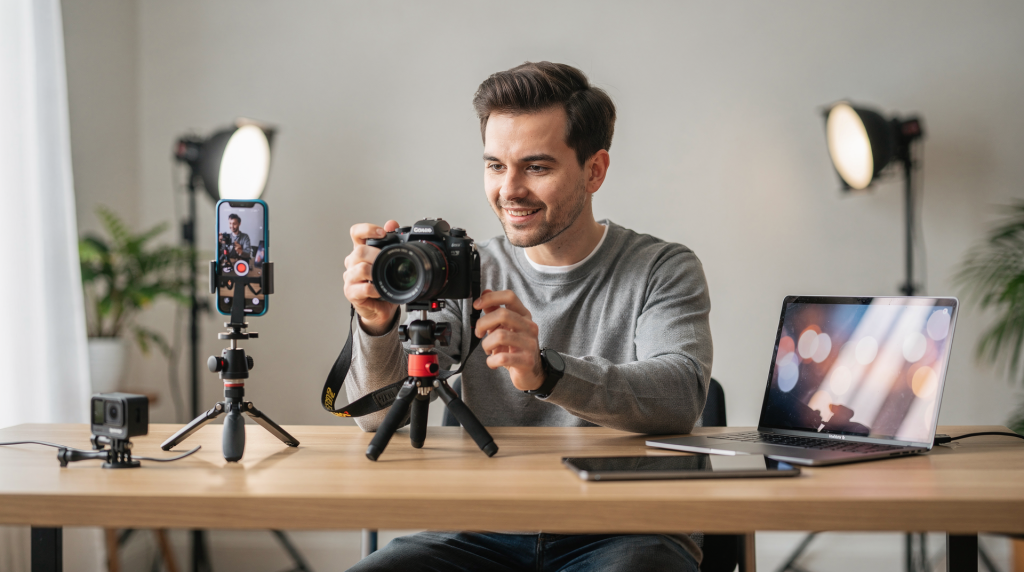
Creative video keeps moving toward formats that feel native, fast, and personal. The strongest trends right now aren’t about chasing polish — they’re about making content easier to watch, easier to trust, and easier to reuse across platforms. When I’m filming a property tour in the morning and cutting a social teaser by lunch, the same principle holds: the format has to serve the viewer’s attention span and the platform’s behavior, not the other way around.
Why creative video trends matter now
The bar for attention is brutally high. Short-form video still dominates every feed, but viewers have developed a kind of immunity to slick production. What they respond to now is content that feels original, useful, and instantly understandable — a walkthrough that shows the real flow of a kitchen, not just a slow pan across granite countertops.
For content creators — especially in real estate — that means the trends worth adopting are repeatable formats that:
- Hold attention in the first few seconds (crucial when a listing has to compete with a dozen others)
- Turn one recording session into multiple assets
- Build trust without overproducing every frame
- Match platform behavior instead of fighting it
I’ve seen agents post the same horizontal full-motion tour on Instagram and wonder why nobody watches. The difference between a scroll and a click often comes down to knowing which trend to lean on for which platform.
The creative video trends worth using in 2026
1. Vertical-first storytelling
Vertical video isn’t an afterthought anymore — it’s the default starting point for mobile distribution, especially on TikTok, Instagram Reels, and YouTube Shorts. What makes it creatively strong is how you design for it: shot composition, text placement, pacing, and reveals built for a phone screen first.
In real estate, this changes how I frame an entrance. Instead of a wide horizontal establishing shot, I might start tight on the front door handle, pull back to reveal the porch, then cut to a vertical walk-through. Captions sit in the lower third where thumbs don’t block them. The goal is to make the content feel like it was born on the device, not repurposed from a TV commercial.
Use it when:
- Your audience watches mostly on mobile (they do)
- You want content to feel platform-native
- You need the same video to work across multiple apps without awkward cropping
2. Behind-the-scenes and unscripted footage
Raw, unscripted content keeps growing because it feels more believable than over-polished posts. In property video, this is gold. Showing the process — not just the pristine final edit — builds a connection that glossy hero shots can’t.
I’ll often capture the setup: adjusting a slider in a narrow hallway, solving ugly reflections in a bathroom mirror, or the moment a homeowner’s dog wanders into frame and we both laugh. These are the clips agents use in Stories and short Reels to humanize a listing. A quick rule: if the audience would think, “I didn’t expect to see that,” it probably has creative value.
This works especially well when you show:
- The process, not just the result
- Mistakes, fixes, and decisions made on-site
- Real people doing real work
- Quick moments that would never make a traditional ad
3. Micro-learning clips
Short educational videos — 15 to 90 seconds — remain powerful because they deliver a clear payoff fast. In the property world, these micro-lessons are the kind of content that agents use to build authority. Think: “Why this room photographs bigger than it is,” or “One lighting mistake most listing videos make.”
The structure is tight: each video answers one specific question without rambling. Viewers don’t want a full lighting course; they want to know how to avoid blowing out windows when shooting a sunrise exterior. These clips rack up saves and shares because they’re immediately useful.
They work best when each video answers a sharp question:
- How do I do this?
- What should I avoid?
- Which option is better?
- What does this term actually mean?
For creators who care about repeat views and being seen as a resource, this format beats surface-level likes every time.
4. Narrative mini-docs
Story-based short videos consistently outperform plain montages because viewers stay when there’s a beginning, middle, and end. A mini-doc can be as short as 90 seconds if it has a clear subject, a tension point, and a payoff.
In real estate, I’ve used this to tell the story of a historic home’s renovation, showing the “before” damage, the mid-construction decision points, and the final walkthrough reveal. It transforms the listing from a collection of rooms into something people watch all the way through. The audience isn’t just touring a house; they’re following a transformation.
Popular examples include:
- A person’s transformation (homeowner, renovator, designer)
- A process from start to finish
- A surprising “how it happened” story
- A quick breakdown of an unusual object, place, or event — like a hidden cellar or a rooftop with a story
5. Creator-led commentary with data or opinion
Formats that blend a strong point of view with evidence are growing because they feel useful and worth saving. In property video, this could be a counter-take on staging myths, a ranking of neighborhood amenities, or a side-by-side comparison of two listing approaches with hard numbers on engagement.
These videos work because they create a reason to keep watching. The viewer wants the conclusion, not just the hook. For example: “Everyone says drone shots sell houses faster — but here’s the problem.” Then you show data on viewer drop-off and a better way to use aerial footage for narrative, not just spectacle.
This includes:
- Counter-take videos
- Myths vs. reality clips
- Data-led commentary
- Ranking formats
- “Everyone says X, but here’s the problem” videos
6. Format remixing
One of the healthiest creative shifts is that creators aren’t inventing every video from scratch. They’re remixing proven structures with their own voice, niche, or perspective. In real estate, this means I can develop a signature “60-second walkthrough” visual template — same opening motion, same text overlay style — and plug in different properties. The audience recognizes the format, and I cut production time drastically.
That might mean:
- Repeating the same visual structure with different topics
- Reusing one editing style across a series
- Turning one long recording into multiple short formats (a full tour, a teaser, a still-with-captions highlight)
- Reworking a trending structure with original footage
This is creative because it helps you produce more without feeding the feed the same thing twice.
7. AI-assisted editing and captions
AI is now widely used to speed up editing, captioning, and repurposing. In real estate video workflows, this is a practical lifesaver. I can drop a 20-minute raw walkthrough into an AI tool, get a rough cut with the dead space removed, and then spend my energy on fine-tuning pacing and adding the human voiceover.
The strongest use cases are strictly practical:
- Auto captions with word-level emphasis (key for silent viewing)
- Rough cuts from longer recordings
- Multiple versions for different platforms
- Translation and localization workflows for international buyers
The key is to keep control over meaning. AI can accelerate production, but it shouldn’t rewrite your message or flatten your style. I still manually adjust every caption that explains a property feature — the nuance matters when you’re describing light or layout.
8. Silent-friendly videos
Many people watch without sound, so videos that still make sense with captions and strong visual pacing perform better. For property walkthroughs, silent-friendly design means that the spatial flow, room transitions, and key selling points must be legible without narration. You add readable on-screen text — “south-facing garden,” “underfloor heating throughout” — and cut more deliberately so that the movement of the camera tells the story.
To build silent-friendly creative videos:
- Add readable on-screen text
- Use visual cues for context (arrows, subtle highlights, split-screens for before/after)
- Keep cuts tight; eliminate any shot that doesn’t communicate something new
- Avoid relying on voice alone
This trend is especially useful for social clips, explainers, and property demos that scroll by in busy feeds.
9. Cross-platform repurposing
One recording session can become several distinct videos when you plan for repurposing from the start. On a property shoot, I might capture a vertical walkthrough, a horizontal hero sequence, and some static detail shots — all in the same visit. Then I edit a full vertical Reel, a shorter teaser, a silent caption-led version for LinkedIn, and a quote clip from the agent’s commentary.
That might include:
- A full vertical post
- A shorter teaser
- A caption-led silent version
- A quote clip
- A platform-specific cut for TikTok, Instagram, or YouTube Shorts
This trend matters because it raises output without forcing you to film more often — and in real estate, you rarely get a second chance to walk a property with ideal light.
10. Community-first content
As platforms get more crowded, creators are leaning into smaller, more engaged audiences instead of trying to reach everyone. For real estate videographers, that might mean tailoring content for first-time buyers in a specific city, or for luxury agents who need to understand architectural details. The creative brief shifts from “Will this go viral?” to “Does this speak to the person who’s actually making a decision?”
Ask yourself:
- Does this speak to a specific viewer?
- Does it reward people who already follow me?
- Does it feel like it was made for this niche?
That mindset consistently leads to better retention and stronger loyalty — and often, the algorithms reward it more than generic reach plays.
Creative video trend comparison
| Trend | Best for | Strength | Common risk |
|---|---|---|---|
| Vertical-first storytelling | Social platforms | Native feel and better mobile viewing | Framing that looks cramped if not planned |
| Behind-the-scenes footage | Trust-building | Feels real and immediate | Looking random instead of intentional |
| Micro-learning clips | Education | High saves and repeat views | Trying to cover too much in one clip |
| Narrative mini-docs | Storytelling | Strong watch time | Weak payoff at the end |
| Data-led commentary | Thought leadership | High share and save potential | Too abstract without concrete examples |
| Format remixing | Consistency | Efficient production | Creative fatigue if overused without variation |
| AI-assisted editing | Scale | Faster output | Loss of personality and tone |
| Silent-friendly videos | Mobile reach | Works without sound | Overloading the screen with text |
How to choose the right trend for your content
Not every trend fits every creator or every property. Pick based on what you actually want the video to do.
If your goal is reach
Use vertical-first edits, fast hooks, remixable formats, and silent-friendly pacing. For a new listing, that means a 15-second vertical teaser with bold captions and a kinetic series of reveals — no long fades, no slow pans.
If your goal is trust
Use behind-the-scenes clips, unscripted moments, mini-doc storytelling, and honest commentary. Agents often need this when building a personal brand — showing the real texture of neighborhoods, not just polished interiors.
If your goal is saves and shares
Use micro-learning clips, data-led insights, myths, mistakes, and comparisons. Think “Three things I never photograph in a rental listing” or “How we saved a $500k listing video with one cheap light.”
If your goal is scale
Use repurposing workflows, AI-assisted captions and rough cuts, and repeatable templates. This is the production backbone — the engine that lets you deliver daily content without burning out.
A practical workflow for using these trends
Step 1: Pick one core idea
Start with one useful topic — a tip, a story, a reaction, or a process. For property video, that might be “how we staged this small condo to look twice the size” or “the mistake most drone pilots make filming waterfront homes.”
Step 2: Choose the format
Match the topic to the format:
- Tip → micro-learning
- Process → behind-the-scenes
- Strong opinion → commentary
- Transformation → mini-doc
A renovation before/after fits naturally into a mini-doc; a quick lighting hack is prime micro-learning.
Step 3: Design for mobile
Keep the frame simple, text readable, and the first second visually clear. In a walkthrough, that might mean opening on a striking detail — a herringbone floor or a wall of windows — before pulling back to show context.
Step 4: Edit for retention
Cut pauses, remove filler, and front-load the value. Don’t wait 10 seconds to reveal the best part of a room. The viewer’s thumb is always hovering.
Step 5: Repurpose
Turn one recording into:
- A main post
- A shorter cut
- A caption-heavy version
- A teaser or follow-up
That single kitchen walkthrough clip might become a Reel, a Story with polls, and a pinned post with a question overlay.
Common mistakes creators make with video trends
- Chasing every trend instead of building a repeatable style — viewers don’t follow inconsistency
- Copying the format but not the reason it works; a silent-friendly video still needs visual logic
- Using AI to speed up production and losing the human voice — especially the tone that makes a property feel lived-in
- Making videos that need sound to make sense, when most real estate scrolling happens on mute
- Treating “creative” as visual decoration instead of audience strategy — adding effects that don’t help a buyer understand the floor plan
- Overediting clips until they feel generic or unnatural; sometimes a handheld walkthrough with breathing room outperforms a hyper-cut montage
Creative video checklist
Before publishing, check whether the video:
- Has one clear idea
- Makes sense in the first 3 seconds
- Works on a phone screen
- Can be understood with or without sound
- Feels native to the platform
- Gives the viewer a reason to watch to the end
- Can be repurposed into another asset
FAQ
What kind of video content is most popular right now?
Short-form vertical content remains dominant, especially when it’s educational, story-driven, or behind-the-scenes. In property, that translates to quick walkthroughs with a clear narrative hook, not just a series of rooms.
Are AI videos replacing human-made content?
No. AI is mostly being used to speed up editing, captions, and repurposing. Human judgment still matters for tone, accuracy, and personality — particularly when you’re trying to convey the feel of a space, which algorithms can’t replicate well.
What video format gets the most engagement?
There’s no single winner, but narrative clips, opinion-led videos, and useful micro-learning content tend to perform strongly because they give viewers a clear reason to keep watching. In real estate, a mini-doc about a home’s history often outperforms a generic tour.
How do creators stay creative without burning out?
Use repeatable formats, record in batches, and remix one core idea into several cuts instead of starting from zero every time. A single property visit can generate a week’s worth of content if you plan for different formats on site.
What should small creators focus on first?
Start with one format that matches your strengths — tutorials, behind-the-scenes clips, or commentary. Consistency beats novelty when you’re trying to grow an audience, especially in niche markets like local real estate.
Final takeaway
The most creative video trends for content creators are the ones that blend originality with structure. The best-performing content right now is mobile-first, story-aware, easy to repurpose, and built around real human value rather than visual noise. In real estate video, that means designing every clip to help a listing stand out and actually connect with a buyer — not just look pretty on a feed.
If you want your videos to stand out, focus less on chasing aesthetics and more on choosing formats that make your ideas easier to watch, easier to trust, and easier to remember. Whether you’re filming a luxury estate or a compact city apartment, the principles stay the same: native framing, honest storytelling, and intentional reuse.